
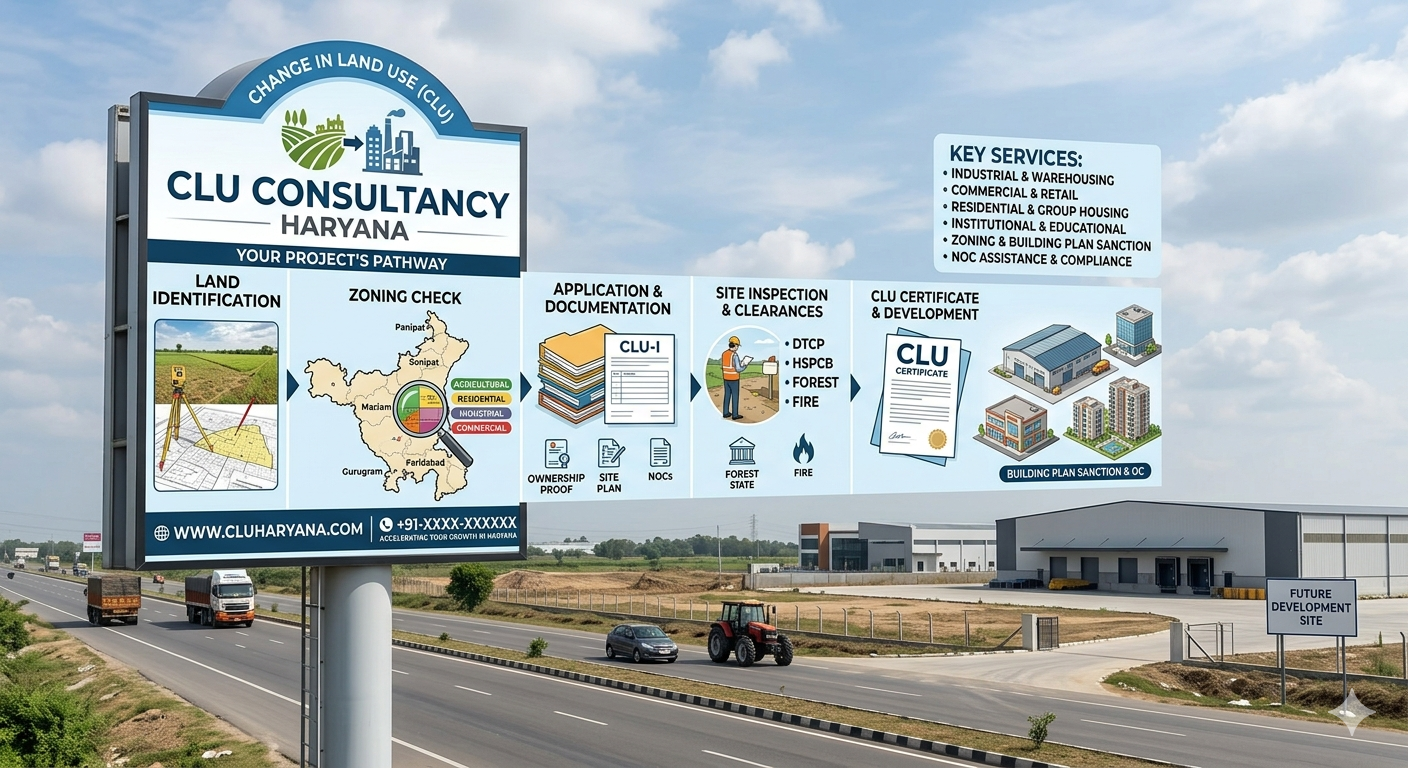
The Complete Guide to CLU (Change of Land Use): Unlocking the True Value of Your Land
Introduction
Land has always been one of the most valuable assets, but in today’s fast-growing economy, its true potential often remains untapped due to regulatory limitations. Many landowners and investors sit on parcels that could be significantly more valuable if used differently—but legal restrictions prevent that transformation. This is where
Change of Land Use (CLU) plays a crucial role.
We specialize in helping individuals, developers, and businesses navigate the CLU process with confidence. This comprehensive guide will walk you through everything you need to know about CLU—what it is, why it matters, how the process works, and how professional consultancy can make all the difference.
Understanding CLU: What Does It Really Mean?
Change of Land Use (CLU) is a formal approval granted by government authorities that allows land to be used for a purpose different from its originally designated category.
For example:
- Agricultural land → Residential use
- Agricultural land → Commercial use
- Industrial land → Mixed-use development
Each piece of land is classified under zoning regulations set by local development authorities. These regulations ensure organized urban growth, environmental protection, and infrastructure planning. However, as cities expand and economic needs evolve, land use must adapt—and CLU makes that possible.
Why CLU is Important in Modern Development
1. Maximizing Land Value
Agricultural land typically has lower market value compared to residential or commercial land. Once CLU is approved, the value of the land can increase dramatically.
2. Enabling Development
Without CLU approval, construction or development may be illegal. CLU ensures that your project is legally compliant and future-proof.
3. Supporting Urban Expansion
As cities grow, land on the outskirts becomes prime for development. CLU enables this transition in a structured and regulated manner.
4. Attracting Investment
Investors are more likely to invest in land that is legally cleared for development. CLU enhances credibility and reduces risk.
The CLU Process: Step-by-Step Breakdown
While the exact process may vary by state or region, the general framework remains similar.
Step 1: Land Assessment
Before applying for CLU, it is essential to evaluate:
- Current land classification
- Location and surrounding development
- Access to roads, utilities, and infrastructure
- Zoning restrictions
This step determines whether your land is eligible for conversion.
Step 2: Application Submission
An application is submitted to the relevant authority (such as the Town Planning Department or Development Authority). This includes:
- Ownership documents
- Land records
- Site plans
- Proposed usage details
Step 3: Scrutiny and Verification
Authorities review the application to ensure:
- Compliance with zoning laws
- No legal disputes or encroachments
- Environmental considerations
Step 4: Site Inspection
In many cases, officials conduct a physical inspection of the land to verify details.
Step 5: Approval and Fees
Once approved, the applicant must pay conversion charges, development fees, and other applicable costs.
Step 6: Issuance of CLU Certificate
After completing all formalities, the CLU certificate is issued, officially permitting the new land use.
Challenges in the CLU Process
While the process may sound straightforward, in reality, it can be complex and time-consuming.
1. Bureaucratic Delays
Multiple departments are often involved, leading to delays if not handled properly.
2. Documentation Errors
Even minor mistakes in paperwork can result in rejection or delays.
3. Changing Regulations
Land laws and policies are subject to change, making it difficult for individuals to stay updated.
4. Legal Complications
Issues such as disputed ownership, land encroachments, or zoning conflicts can complicate the process.
5. Lack of Clarity
Many applicants are unsure about eligibility, required documents, or the correct procedure.
How Professional CLU Consultancy Helps
This is where we step in to simplify the journey.
Expert Evaluation
We assess your land thoroughly to determine the feasibility of CLU approval before you invest time and money.
End-to-End Support
From documentation to final approval, we manage the entire process on your behalf.
Faster Approvals
Our experience and network help reduce delays and streamline approvals.
Risk Mitigation
We identify potential issues early and address them proactively.
Transparent Guidance
We keep you informed at every stage, ensuring clarity and confidence.
Types of CLU Conversions
Agricultural to Residential
Ideal for housing projects, plotted developments, or farmhouses.
Agricultural to Commercial
Suitable for shops, offices, retail spaces, and business hubs.
Agricultural to Industrial
Used for factories, warehouses, and manufacturing units.
Mixed-Use Development
Combines residential, commercial, and recreational spaces.
Key Factors That Influence CLU Approval
Location
Land near urban areas or highways has a higher chance of approval.
Infrastructure Availability
Access to roads, water, electricity, and sewage systems is crucial.
Environmental Impact
Authorities assess whether the conversion will harm the environment.
Master Plan Compliance
The proposed land use must align with the region’s master development plan.
Cost of CLU: What to Expect
CLU involves several costs, including:
- Conversion charges
- External development charges (EDC)
- Infrastructure development fees
- Application and processing fees
The total cost varies based on location, land size, and intended use.
Common Mistakes to Avoid
- Applying without feasibility analysis
- Submitting incomplete documents
- Ignoring zoning regulations
- Underestimating costs
- Attempting to navigate the process without expert help
Why Choose us for CLU Services?
Proven Expertise
Our team has extensive experience in handling CLU cases across various regions.
Personalized Approach
We understand that every land parcel is unique, and we tailor our strategy accordingly.
Efficiency and Speed
We prioritize timely execution to help you achieve your goals faster.
End-to-End Solutions
From initial consultation to post-approval support, we are with you every step of the way.
Real-World Impact of CLU
Imagine owning agricultural land on the outskirts of a growing city. Without CLU, its use and value are limited. With CLU approval, the same land can be transformed into:
- A residential township
- A commercial complex
- A logistics hub
This transformation not only increases the land’s value but also contributes to economic growth and infrastructure development.
Future of Land Development and CLU
As urbanization continues to accelerate, the demand for land conversion will only increase. Governments are also working toward digitizing land records and simplifying approval processes, making CLU more accessible.
However, with increasing demand comes stricter regulations—making professional guidance even more important.
Frequently Asked Questions (FAQs)
How long does CLU approval take?
It can take anywhere from a few months to over a year, depending on the complexity and location.
Is CLU mandatory for construction?
Yes, if the land’s current classification does not permit the intended use.
Can CLU be rejected?
Yes, if the land does not meet eligibility criteria or violates regulations.
Can I apply for CLU myself?
While possible, it is not recommended due to the complexity involved.
Conclusion
Change of Land Use is more than just a regulatory requirement—it is a strategic tool that can unlock immense value and opportunity. Whether you are a landowner, investor, or developer, understanding and leveraging CLU can significantly impact your financial and development goals.
However, the process requires expertise, precision, and a deep understanding of regulations. That’s where we comes in.
Get Expert CLU Assistance Today
If you’re planning to convert your land or explore its full potential, don’t navigate the process alone. Let experts handle the complexities while you focus on your vision.
Connect with us today and take the first step toward transforming your land into a high-value asset.


